

YAML Metadata Warning:empty or missing yaml metadata in repo card
Check out the documentation for more information.
Exo-Machina
A deep language model, GPT-2, is trained on scientific manuscripts from NASA's Astrophysical Data System pertaining to extrasolar planets and the references therein. This pilot study uses the abstracts of each article as training data in order to explore correlations in scientific literature from a language perspective. A language model is a mathematical representation for an algorithm used to generate sequences in the same way a human would to form sentances. Each word or letter in a sentance is encoded to a numerical value (e.g. using word2vec) and is appended to a list forming sequences that represent up to a paragraph worth of text. The sequences are fed into the GPT-2 117M model and trained for 500,000 steps with fine tuning. After training, the language model is used to generate new text from scratch and from user input.
Get started fast:
from transformers import pipeline

exo = pipeline('text-generation',model='pearsonkyle/gpt2-exomachina', tokenizer='gpt2', config={'max_length':1600})
machina = lambda text: exo(text)[0]['generated_text']

print(machina("Transiting exoplanets are"))
Training Samples
~40,000 Abstracts from NASA's Astrophysical data system (ADS) and ArXiv.
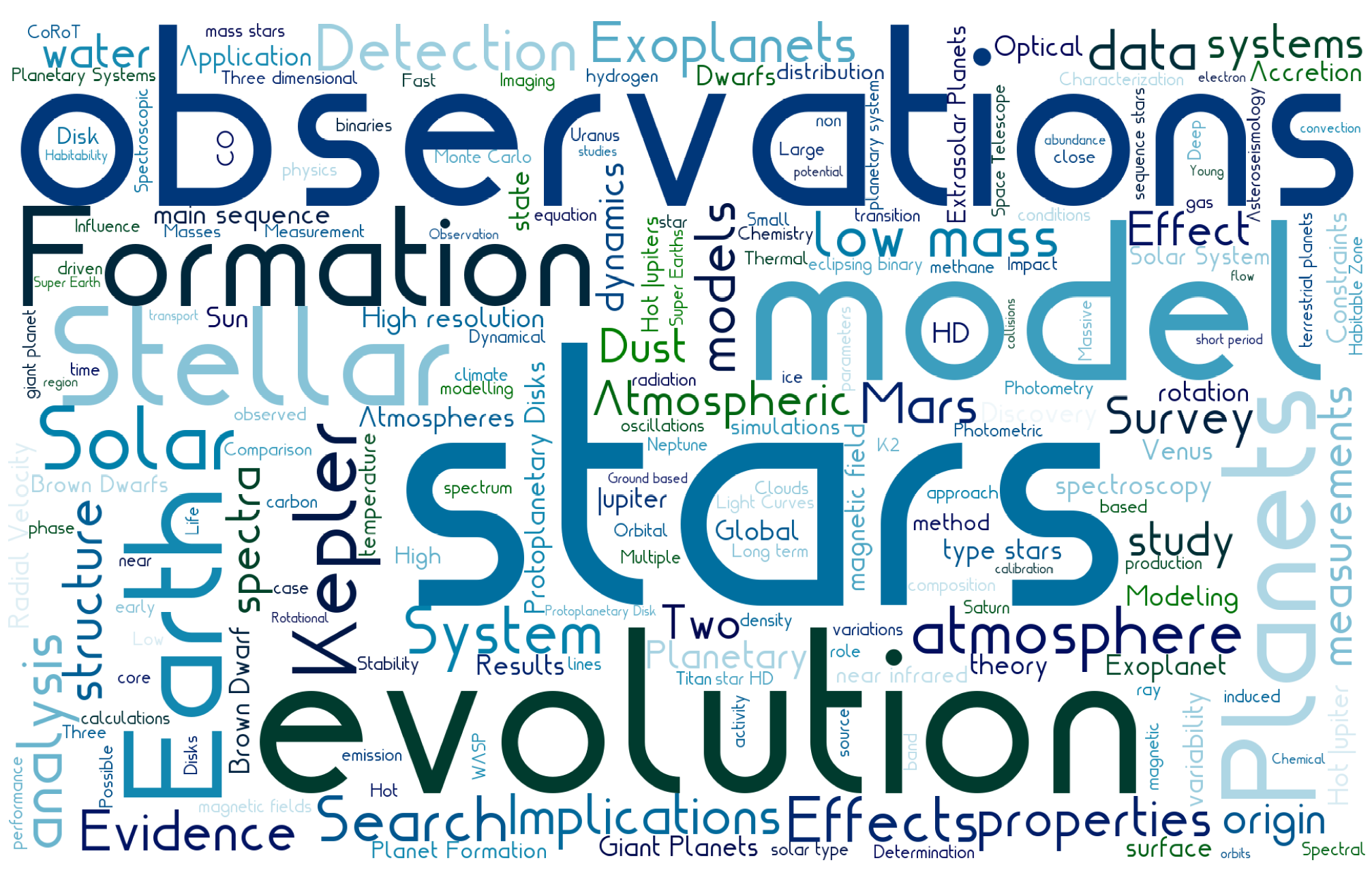
A few generated samples are below:
- We can remotely sense an atmosphere by observing its reflected, transmitted, or emitted light in varying geometries. This light will contain information on the planetary conditions including
temperature, pressure, composition, and cloud optical thickness. One such property that is important is... - The reflectance of Earth's vegetation suggests
that large, deciduous forest fires are composed of mostly dry, unprocessed material that is distributed in a nearly patchy fashion. The distributions of these fires are correlated with temperature, and also with vegetation... - Directly imaged exoplanets probe
key aspects of planet formation and evolution theory, as well as atmospheric and interior physics. These insights have led to numerous direct imaging instruments for exoplanets, many using polarimetry. However, current instruments take
Letting the scrape run for ~2 hours found articles from these publications:
 5364 - The Astrophysical Journal
 3365 - Astronomy and Astrophysics
 2704 - Monthly Notices of the Royal Astronomical Society
 1355 - The Astronomical Journal
 617 - arXiv e-prints
 498 - Icarus
 388 - Publications of the Astronomical Society of the Pacific
 324 - The Astrophysical Journal Supplement Series
 245 - Nature
 187 - Journal of Geophysical Research
 167 - Science
 145 - Astronomische Nachrichten
 129 - Planetary and Space Science
 114 - Space Science Reviews
 109 - Geophysical Research Letters
- Downloads last month
- 5