

Roadmap
Collection
Development Roadmap • 25 items • Updated • 1
The model is NMS-free. It predicts a fixed set of objects and is trained with Hungarian bipartite matching.
This is v1: a single from-scratch training run with no pretraining, no hyperparameter search across seeds, and none of the planned ablations run yet. Treat everything below as a first checkpoint in an ongoing process, not a finished result. v2 is expected to do meaningfully better, whether that comes from more training compute, an architecture change informed by v1's ablations, or both.
| Parameters | 40.8M |
| Epochs | 100 / 100 (complete) |
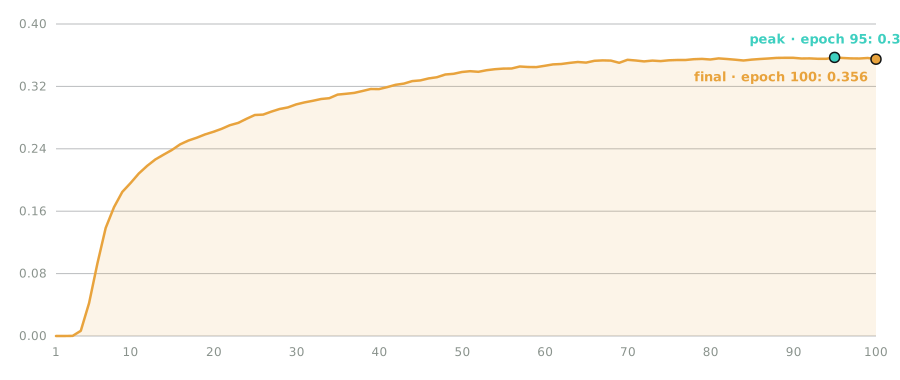
| Peak val AP (IoU 0.50:0.95) | 0.358 (epoch 95) |
| Final val AP (epoch 100) | 0.356 |
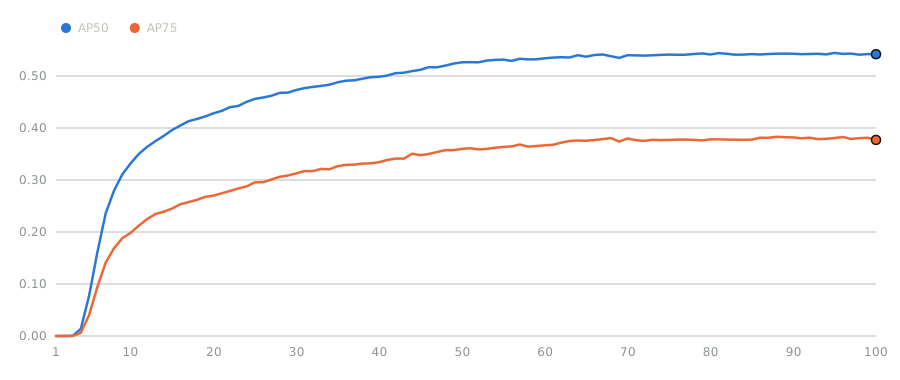
| Val AP50 / AP75 | 0.544 / 0.381 |
| Val AP small / medium / large | 0.188 / 0.387 / 0.493 |
| Val AR@100 | 0.573 |
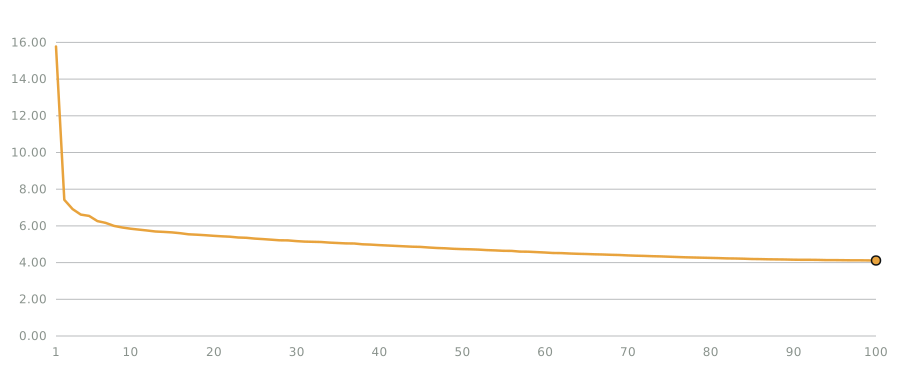
| Train loss | 4.11 (from 15.77 at epoch 1) |
| Throughput | ~90-110 img/s, batch 32, RTX 5090 |
| Single-frame inference | 30.7 ms / 32.5 FPS (batch 1, eager, RTX 5090) |
Train loss over the same run, log-shaped as expected for a detector trained from scratch:
AP50 (IoU 0.50, a looser localization threshold) against AP75 (IoU 0.75, stricter). Both climb together early on, then AP75 plateaus lower, meaning coarse localization improved faster than precise localization did:
AP broken out by object size. Large objects are detected far more reliably than small ones throughout training, a common pattern for this class of detector and one of the things the required ablations would need to explain:

Peak AP came at epoch 95 (0.3578), not the final epoch. That is normal late-training fluctuation,
and best.pt correctly holds the epoch-95 weights rather than epoch 100's. Against the 40-50 AP
range set as the competitiveness bar, this run falls short. It is a real result from a genuine
from-scratch run, on the low end of what the project was aiming for.
The gap is exactly what the Minimum Validation Protocol exists to
characterize properly: whether more decoder layers, more latents, longer training, or pretraining
would close it is unknown without actually running those ablations.
Six detections from the final EMA checkpoint (epoch 95, peak AP) on COCO val2017 images, confidence ≥ 0.35. Picked for variety, not cherry-picked for perfection.
 |
 |
| Dessert tray, bottle, bowl, and a dozen individually boxed items | Skate park, parent and child, skateboard at 0.93 confidence |
 |
 |
| Street market, person at 0.94, market umbrella | Rodeo, crowd of people, one animal still mislabeled |
 |
 |
| Family at a table, cups, chair, bottle, two people | Beach, kite at 0.80, people along the shore, a distant boat |

ObjectModel-v1 itself has no temporal component. Every frame is detected independently. The clip
above chains detections through a from-scratch SORT-style tracker (src/objectmodel_v1/tracking.py:
constant-velocity Kalman motion model plus IoU/Hungarian frame-to-frame association) to give boxes
a persistent id and a short motion trail. Source footage is vtest.avi, OpenCV's standard
pedestrian test clip (BSD-3, ships with OpenCV), genuine video the model never trained on.
This is the same clip run at three points in training, tracker unchanged throughout. Only the detector's checkpoint improved:
| Checkpoint | Ids issued over 20s | Longest-lived ids |
|---|---|---|
| Epoch 13 (AP 0.227) | ~89 | none survive past a few seconds |
| Epoch 26 (AP 0.288) | ~84 | 3 ids survive nearly the full clip |
| Epoch 95 (AP 0.358, peak) | 92 | 4 ids survive nearly the full clip |
Track count issued does not fall much, since new people keep entering frame throughout the clip and each one earns a new id, which is correct behavior. Track persistence for people already in frame improved consistently instead. A separate test on a genuinely different scene, an eye-level warehouse clip not shown here, also surfaced a real and distinct limitation: the detector still occasionally hallucinates objects on plain background surfaces, reading a support pillar as "refrigerator", even at this peak checkpoint. Tracking quality rides on detection quality, and detection quality on out-of-domain footage (camera angles, lighting, and compression that COCO's photos do not really cover) is visibly weaker than on COCO's own validation images.

A small layer on top of the tracker: src/objectmodel_v1/zones.py defines a polygon in the same
pixel coordinates as the tracked boxes, and fires an event only on the transition into or out of
it, not on every frame a track spends inside. It keys off each box's bottom-center point (roughly
where feet touch the ground) rather than the box centroid, since a zone drawn on a floor plane
should care where someone is standing, not where their torso is.
Correctness is checked on a synthetic sequence, not just eyeballed on video: a track walking
through a rectangle produces exactly one entered and one exited event, none of the frames
spent inside re-fire, a track that never enters never fires, and a fresh id gets independent
state. That test lives with the module.
On the same plaza clip used above, the zone above the walkway fired 91 enter/exit events over 20 seconds. Read that number carefully: most of it is not 91 different real crossings. It is the same tracker id churn already described in the section above, the same person's track resetting and re-entering the zone as a "new" id, plus a handful of misclassified objects (a backpack or handbag read as its own tracked object) that shouldn't have triggered an event at all. The event mechanics are verified correct; the real-world event count is exactly as reliable as the underlying detector and tracker are, which right now is "usable for a demo, not for anything where a false alert has a real cost."
from objectmodel_v1.zones import RestrictedZoneMonitor

zone = [(300, 150), (650, 150), (650, 320), (300, 320)]  # pixel-space polygon
monitor = RestrictedZoneMonitor(zone)

for frame_index, frame in enumerate(video_frames):
    boxes, labels, scores = detect(frame)
    tracks = tracker.update(boxes, labels, scores)
    for event in monitor.update(tracks, frame_index):
        print(event.track_id, event.kind, event.position)  # "entered" or "exited"
image
  -> compact convolutional backbone (strides 8/16/32)
  -> top-down pyramid fusion
  -> pooled multi-scale tokens
  -> fixed latent memory (global semantics)
  -> learned object queries
       -> query self-attention
       -> cross-attention to latent memory
       -> local sampling around the current query box
       -> iterative class and box prediction
  -> object set (no anchors, no NMS)
The local sampling radius scales with each query's current width and height. Early decoder layers can search broadly; later layers focus naturally as boxes are refined. During training, an optional dense auxiliary head adds one-to-many spatial supervision. It is discarded for inference and must be evaluated as an ablation, not assumed to help.
Use Python 3.11 or another PyTorch-supported Python version:
python3.11 -m venv .venv
.venv/bin/pip install --upgrade pip
.venv/bin/pip install -e '.[coco,export,dev]'
For a specific CUDA build, install the matching PyTorch wheel first using the command from https://pytorch.org/get-started/locally/, then install ObjectModel-v1.
The default configuration expects COCO 2017:
/path/to/coco/
  annotations/instances_train2017.json
  annotations/instances_val2017.json
  train2017/*.jpg
  val2017/*.jpg
Category IDs are mapped to contiguous training labels and converted back during evaluation. Images without target objects are supported.
Profile the model before allocating training compute:
objectmodel-profile --config configs/objectmodel_v1.yaml --device cuda
Overfit a small dataset first. A full single-GPU command is:
objectmodel-train \
  --config configs/objectmodel_v1.yaml \
  --data-root /path/to/coco \
  --output outputs/objectmodel_v1
Distributed training:
torchrun --standalone --nproc_per_node=8 -m objectmodel_v1.train \
  --config configs/objectmodel_v1.yaml \
  --data-root /path/to/coco \
  --output outputs/objectmodel_v1
Resume and override configuration values:
objectmodel-train \
  --config outputs/objectmodel_v1/config.yaml \
  --data-root /path/to/coco \
  --output outputs/objectmodel_v1 \
  --resume outputs/objectmodel_v1/last.pt \
  --set train.batch_size=8
Evaluate the EMA checkpoint with canonical pycocotools metrics:
objectmodel-eval \
  --config outputs/objectmodel_v1/config.yaml \
  --checkpoint outputs/objectmodel_v1/best.pt \
  --data-root /path/to/coco
Export raw logits and normalized cxcywh boxes to ONNX:
objectmodel-export \
  --config outputs/objectmodel_v1/config.yaml \
  --checkpoint outputs/objectmodel_v1/best.pt \
  --output outputs/objectmodel_v1/objectmodel-v1.onnx
Track detections across video frames (see Live Tracking Demo; this is a post-processing layer over independent per-frame detections, not a model capability):
from objectmodel_v1.tracking import SortTracker

tracker = SortTracker(iou_threshold=0.3, max_age=5, min_hits=2)
for frame in video_frames:
    boxes, labels, scores = detect(frame)  # your decode_predictions() call
    for t in tracker.update(boxes, labels, scores):
        print(t.id, t.box, t.label, t.score)
Before describing ObjectModel-v1 as competitive, run all models on the same COCO train2017 and val2017 data, image resolution, augmentation budget, training epochs, and hardware. Report:
Required ablations:
| Experiment | Question |
|---|---|
| latent memory vs flattened feature attention | Does compression preserve useful global context? |
| local sampler disabled | Does high-resolution geometric evidence improve localization? |
| fixed vs box-scaled offsets | Does coarse-to-fine sampling matter? |
| dense auxiliary head disabled | Does added supervision improve convergence? |
| 1/2/3 latent layers | Where is the accuracy/latency optimum? |
| 32/64/96 latents | How aggressively can global context be compressed? |
| 3/4/6 decoder layers | What is the anytime speed/accuracy curve? |
Suggested external baselines are RT-DETR-R18, D-FINE-N/S, LW-DETR-T/S, and YOLOX-S. Use their official implementations and report their license and measurement setup separately.
Two different questions worth separating: what this pipeline could be extended to do without touching the detector, and what would actually make the detector itself better in v2.
Extensions on top of the current detector and tracker. The zone monitor above is one instance
of a general pattern: detector output plus SortTracker's persistent ids is enough to build most
counting and monitoring logic without retraining anything.
zones.py's pattern.RestrictedZoneMonitor, a line-side test instead of
polygon containment.Behavior or anomaly detection (wrong-way movement, erratic motion) and multi-camera re-identification are real extensions but not close additions. Both need work this repository does not do yet: proper motion modeling beyond a Kalman filter, and cross-camera identity matching.
What v2 would actually need to change. Three things came out of this run as specific, not generic:
None of this is scheduled work, it's the concrete list of what the data from this run actually points at, as opposed to a generic "train bigger, train longer."
ObjectModel-v1 builds on published, independently attributable ideas:
ObjectModel-v1's specific hypothesis is the combination of a fixed compressed global memory and box-scaled local pyramid sampling. Publication novelty requires a broader prior-art search and empirical ablations; this repository does not claim that the combination is patent-new.
Apache License 2.0. Dataset images, annotations, pretrained weights, and external baselines retain their own licenses and are not included.