

File size: 7,115 Bytes
9fe95c5 28baff4 0767987 28baff4 43a3533 28baff4 0767987 28baff4 | 1 2 3 4 5 6 7 8 9 10 11 12 13 14 15 16 17 18 19 20 21 22 23 24 25 26 27 28 29 30 31 32 33 34 35 36 37 38 39 40 41 42 43 44 45 46 47 48 49 50 51 52 53 54 55 56 57 58 59 60 61 62 63 64 65 66 67 68 69 70 71 72 73 74 75 76 77 78 79 80 81 82 83 84 85 86 87 88 89 90 91 92 93 94 95 96 97 98 99 100 101 102 103 104 105 106 107 108 109 110 111 112 113 114 115 116 117 118 119 120 121 122 123 124 125 126 127 128 129 130 131 132 133 134 135 136 137 138 139 140 141 142 143 144 145 146 147 148 149 150 151 152 153 154 155 156 157 158 159 160 161 162 163 164 165 166 167 168 169 170 171 172 173 174 175 176 177 178 179 180 181 182 183 184 185 186 187 188 189 190 191 192 193 194 195 196 197 198 | ---
license: other
license_name: ngen3-community-license
license_link: https://tnsaai-builds.framer.website/community/licenses/ngen3
model-index:
- name: NGen-3-1B-it
results:
- task:
type: text-generation
dataset:
name: TCorpus5
type: WebCorpus
metrics:
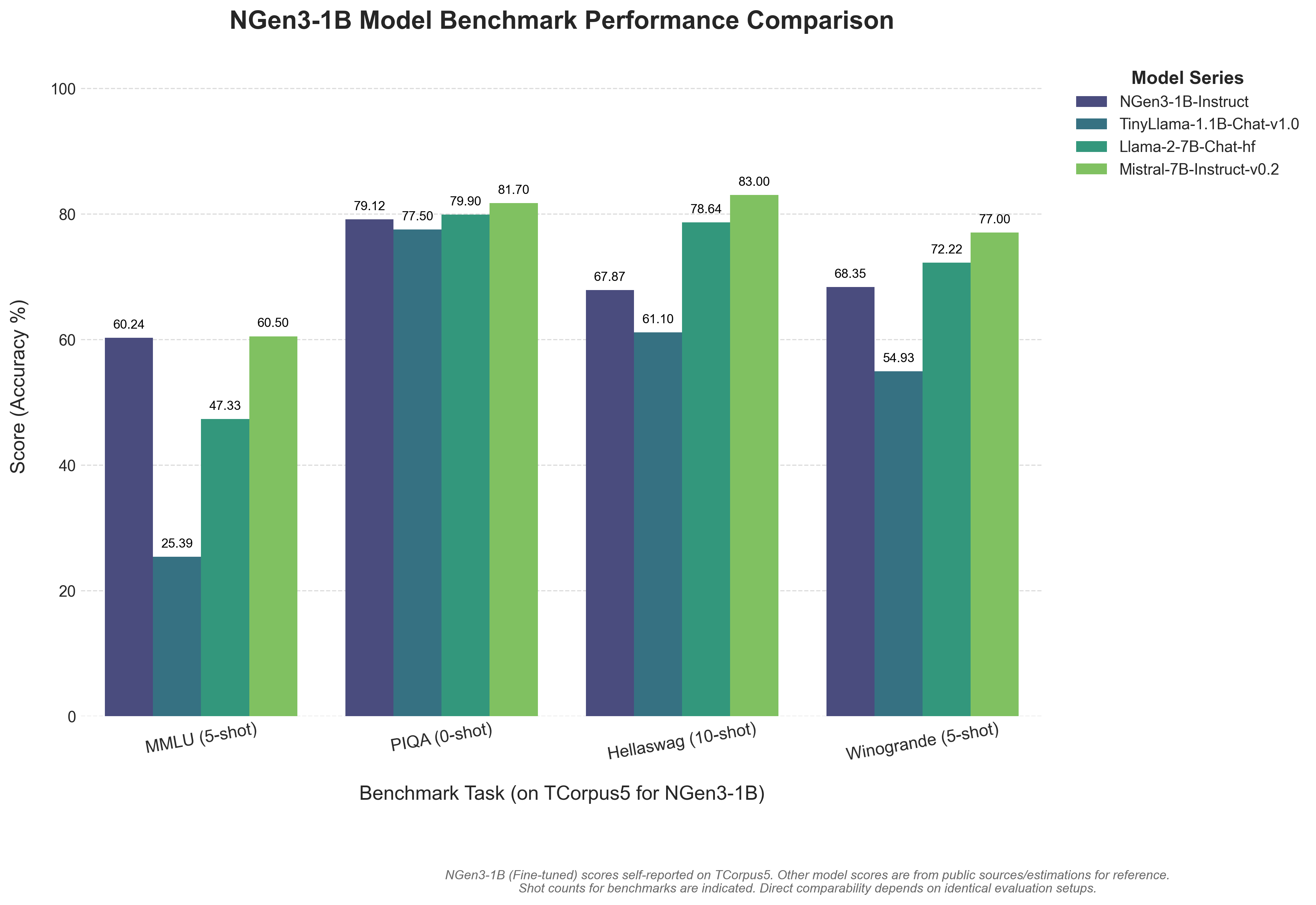
- name: MMLU
type: accuracy
value: 60.24
- name: PIQA
type: accuracy
value: 79.12
- name: Hellaswag
type: accuracy
value: 52.87
- name: Winogrande
type: accuracy
value: 68.35
pipeline_tag: text2text-generation
datasets:
- HuggingFaceH4/no_robots
- Open-Orca/SlimOrca
- Skylion007/openwebtext
- HuggingFaceFW/fineweb
- HuggingFaceTB/smoltalk
base_model:
- TNSA/NGen3-1B
---
# **This Model is Primarily was NGen3-1B-it converted to Chunks for faster Inference and Tuning of the Model**
# NGen 3 - 1B-Instruct(Chunked)
NGen3 is a production-level foundational language model inspired by state-of-the-art architectures such as GPT-4, Claude-3, and Llama 2. It is designed for both research and production and supports model variants ranging from 7M to 1B parameters. The model is built with a modular transformer decoder architecture and provides a comprehensive command-line interface (CLI) for tokenization, training, sampling, exporting, knowledge distillation, and fine-tuning on conversational data.

## Table of Contents
- [Overview](#overview)
- [Model Architecture](#model-architecture)
- [Installation](#installation)
- [Usage](#usage)
- [Tokenization](#tokenization)
- [Training](#training)
- [Sampling](#sampling)
- [Exporting](#exporting)
- [Knowledge Distillation](#knowledge-distillation)
- [Fine-Tuning](#fine-tuning)
- [Local Fine-Tuning](#local-fine-tuning)
- [Hugging Face Fine-Tuning](#hugging-face-fine-tuning)
- [Hyperparameters](#hyperparameters)
- [Acknowledgements](#acknowledgements)
---
## Overview
NGen3 is a flexible, self-contained implementation of a foundational language model built on a transformer decoder architecture. It enables users to:
- **Tokenize** text from local files, URLs, or directly from Hugging Face datasets.
- **Train** the model on tokenized datasets.
- **Generate** text samples from trained models.
- **Export** models (with minimal tokenizer configurations) to formats compatible with Hugging Face.
- **Distill** knowledge from larger teacher models into smaller student models.
- **Fine-Tune** on conversational datasets (using local files or datasets from Hugging Face).
---
## Model Architecture
NGen3 uses a decoder-only transformer design with the following components:
- **Token & Positional Embeddings:** Learnable embeddings for tokens and their positions.
- **Transformer Blocks:** A stack of blocks, each containing:
- **Causal Self-Attention:** Multi-head attention with a lower-triangular mask to prevent attention to future tokens.
- **Feed-Forward Network (MLP):** With GELU activation.
- **Residual Connections & Layer Normalization:** To stabilize training.
- **Final Projection Layer:** Projects the hidden states to logits over the vocabulary.
The model comes in several variants:
- **7M Variant:** 4 layers, 4 heads, 128-dimensional embeddings.
- **120M Variant:** 12 layers, 8 heads, 512-dimensional embeddings.
- **300M, 500M, 700M, and 1B Variants:** Increasing in depth and width.
---
## Evaluation Results
## Installation
Ensure you have Python 3.8+ installed and install the necessary dependencies:
```bash
pip install torch transformers datasets tqdm safetensors
```
## Usage
NGen3 is fully managed via a CLI. Below are examples for each command.
Tokenization
Local Text File or URL:
```bash
python _model_.py tokenize --dataset tinyshakespeare --txt "https://raw.githubusercontent.com/karpathy/char-rnn/master/data/tinyshakespeare/input.txt"
```
Hugging Face Dataset:
```bash
python _model_.py hf_tokenize --hf_dataset roskoN/dailydialog --hf_split train --hf_text_column utterances --dataset dailydialog_train
```
## Training
Train a model variant (e.g., 7M):
```bash
python _model_.py train --variant 7M --data _data_tinyshakespeare_/data.bin
```
## Sampling
Generate text samples from a trained model:
```bash
python _model_.py sample --variant 7M --model_checkpoint 7M_model.pt --prompt "To be, or not to be" --length 100 --temperature 1.0
```
## Exporting
Export a trained model (and its tokenizer configuration) for Hugging Face:
```bash
python _model_.py export --variant 7M --model_path 7M_model.pt --output_dir exported_7M
```
## Knowledge Distillation
Distill a larger teacher model (e.g., GPT-2 120M from HF) into a smaller student model (e.g., 7M):
```bash
python _model_.py distill --teacher_model_path hf --teacher_variant 120M --student_variant 7M --data _data_tinyshakespeare_/data.bin --temperature 2.0 --alpha 0.5
```
## Fine-Tuning
Local Fine-Tuning on Conversational Data
Fine-tune a distilled model using local conversation data:
```bash
python _model_.py finetune --variant 120M --model_checkpoint distilled_120M_model.pt --data _data_conversations_/data.bin --finetune_iters 1000 --prompt "Hello, how are you?" --sample_length 100 --sample_temperature 1.0
```
Hugging Face Fine-Tuning on a Conversational Dataset
Fine-tune on a conversational dataset from Hugging Face (e.g., roskoN/dailydialog):
```bash
python _model_.py hf_finetune --variant 120M --model_checkpoint distilled_120M_model.pt --hf_dataset roskoN/dailydialog --hf_split train --hf_text_column utterances --finetune_iters 1000 --prompt "Hello, how are you?" --sample_length 100 --sample_temperature 1.0
```
## Sampling and Exporting Fine-Tuned Models
After fine-tuning, you can sample from or export the fine-tuned model just as with any checkpoint. For example, if your fine-tuned model is saved as finetuned_120M_model.pt:
Sampling:
```bash
python _model_.py sample --variant 120M --model_checkpoint finetuned_120M_model.pt --prompt "What do you think about AI?" --length 100 --temperature 1.0
```
Exporting:
```bash
python _model_.py export --variant 120M --model_path finetuned_120M_model.pt --output_dir exported_finetuned_120M
```
## Hyperparameters
Each model variant comes with predefined hyperparameters. For example:
7M Variant:
Layers: 4, Heads: 4, Embedding Dimension: 128
Block Size: 128, Batch Size: 16, Learning Rate: 3e-4
120M Variant:
Layers: 12, Heads: 8, Embedding Dimension: 512
Block Size: 256, Batch Size: 32, Learning Rate: 3e-4
300M, 500M, 700M, 1B Variants:
Increasing layers, heads, and embedding dimensions for better performance.
Adjust ```max_iters```, ```log_interval```, and ```eval_interval``` to suit your dataset size and computational resources.
## Acknowledgements
NGen3 is inspired by leading models including GPT-4, Claude-3, and Llama 2. Special thanks to the open-source community for:
- PyTorch
- Hugging Face Transformers
- Hugging Face Datasets
- safetensors |